
Understanding Farmland Investment in India: Returns, Risks & Long-Term Value

In the last few years, farmland has quietly moved from being a traditional rural asset to a serious consideration for modern investors With cities expanding rapidly and land becoming increasingly scarce, many are now asking a very practical question — is farmland a good investment in India in 2026?
The answer isn’t as simple as comparing numbers. Farmland works differently from stocks or urban real estate. It is not driven by daily market sentiment, but by long-term fundamentals such as land demand, infrastructure growth, and agricultural productivity. That is precisely what makes it interesting for investors who are looking beyond short-term gains.
Is Farmland a Good Investment in India in 2026?
Farmland today represents something more than ownership of land — it represents participation in a growing asset class backed by real demand. As urban areas expand, agricultural land located near these growth corridors tends to appreciate steadily over time.
Unlike volatile investments, farmland rewards patience. It is a long-term play where value builds gradually, supported by factors such as connectivity, water access, and surrounding development. For investors who prefer stability over speculation, this creates a strong foundation for wealth creation.
Understanding Farmland Returns and ROI in India
One of the key differences between farmland and other asset classes is the way returns are generated. Farmland does not rely on a single source of income. Instead, it offers a combination of land appreciation and agricultural earnings.
On one side, the land itself appreciates as demand increases and infrastructure develops. On the other, it can generate income through cultivation, leasing, or managed farming models. Over time, these two elements work together to create a compounding effect that is difficult to replicate in many traditional investments.
This dual nature of returns is what makes farmland particularly relevant in today’s environment, where investors are increasingly looking for both growth and income from the same asset.
To put this into perspective, it helps to compare farmland with other common investment options across multiple factors — not just returns, but also risk, liquidity, and real-world performance.
Farmland vs Other Investments (2026)
Based on real 2026 market trends
| Investment | 2026 Data | Risk | Sell Speed | Returns | Market Reality |
|---|---|---|---|---|---|
|
🌿 Farmland Best Long-Term Asset |
8–17% avg returns, up to 22% long-term | Low–Medium | Slow | High | Land scarcity, urban expansion, real demand growth |
| 📈 Stocks | ~12% long-term, volatile in 2026 | High | Very Fast | High | Market volatility, global risks, FII outflows |
| 📊 Mutual Funds | ₹40,450 Cr inflows (Mar 2026) | Medium | Fast | Moderate–High | Strong investor participation despite volatility |
| 💰 SIP | ₹32,087 Cr monthly inflow | Medium | High | Moderate | Consistent retail investment growth |
| 🏦 Fixed Deposits | 6.75% – 7.25% | Very Low | Medium | Low | Safe but limited returns |
| 🥇 Gold | ₹90K – ₹1.7L range | Low–Medium | Fast | Moderate | Depends on global economy & inflation |
| 🏠 Real Estate | -4% sales decline (Q1 2026) | Medium | Slow | Moderate | Demand slowdown in some regions |
As the comparison shows, farmland stands out for its balance. It may not offer instant liquidity like stocks, but it provides something equally valuable — stability, predictable growth, and the ability to generate passive income over time.
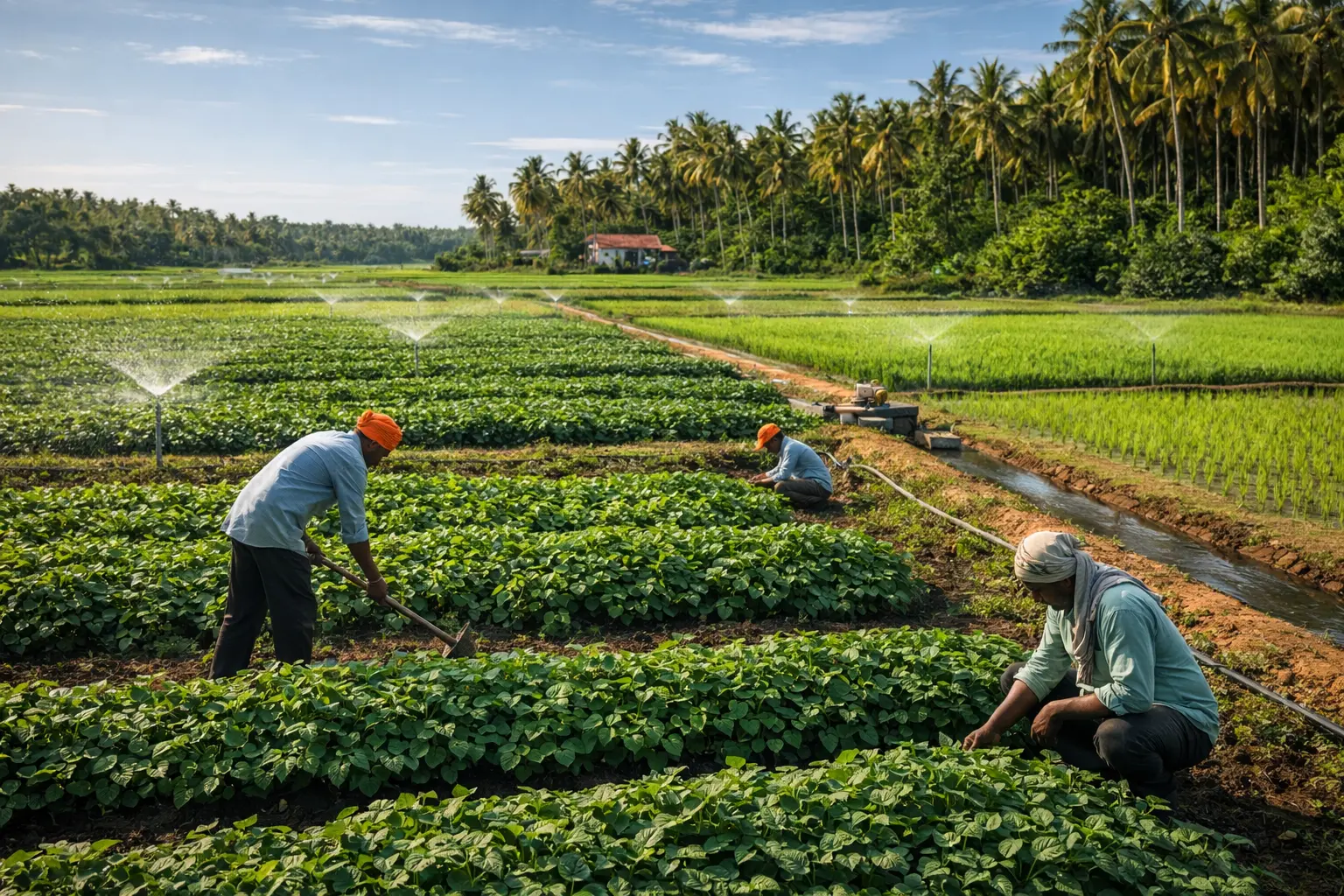
Understanding Farmland Risks: A Realistic Perspective
Every investment comes with its own set of risks, and farmland is no exception. However, the nature of these risks is quite different from what investors experience in financial markets.
In farmland, risks are largely linked to execution — factors such as land title clarity, water availability, and proper farm management. These are not unpredictable risks, but manageable ones that can be addressed with the right due diligence.
The emergence of managed farmland models has further reduced these concerns. By handling operations, maintenance, and compliance, these models allow investors to participate without needing hands-on involvement, making farmland far more accessible than it was in the past.
Key Insights: Why Investors Are Shifting Towards Farmland
The growing interest in farmland is not accidental. It reflects a broader shift in how investors think about wealth and security. In an environment where markets can be volatile and uncertain, tangible assets are gaining renewed importance.
Farmland is supported by fundamental demand — food production, land scarcity, and long-term sustainability. Unlike speculative assets, its value is tied to real-world use and necessity. This gives it a level of resilience that many other investments struggle to maintain.
Additionally, farmland aligns with a long-term vision. It is not just about returns in the next year or two, but about building an asset that continues to grow and remain relevant over decades.
Organic Farming & Managed Farmland: What Investors Should Know
1. Why is managed farmland becoming a popular investment in India?
Managed farmland is gaining attention due to growing land demand, urban expansion, and structured farm management. It offers a combination of long-term appreciation and stability compared to market-linked assets.
2. What makes farmland a stable long-term asset?
Farmland is a physical asset with limited supply and increasing demand. Unlike financial markets, it is less affected by daily volatility and benefits from long-term growth factors.
3. What risks do unmanaged farmlands typically face?
Unmanaged farms often suffer from poor soil health, pest damage, water mismanagement, and lack of scientific planning, which can reduce both yield and long-term land value.
4. How does managed farmland reduce uncertainty for investors?
Managed farmland uses expert supervision, structured plantation models, and consistent maintenance, ensuring that the land develops systematically over time instead of depending on unpredictable outcomes.
5. What factors drive long-term value in farmland?
Key factors include location, water availability, crop selection, and infrastructure growth. These directly impact both productivity and appreciation potential.
6. Why is location important in farmland investment?
Location determines both future demand and accessibility. Areas near expanding cities or infrastructure developments tend to show stronger land value growth over time.
7. How should investors evaluate a farmland project before investing?
Investors should assess soil quality, water resources, farm management, crop planning, and long-term vision to ensure a well-structured and reliable investment.
Conclusion
Farmland investment in India is evolving into a structured and credible asset class. While it may not suit those looking for quick gains, it offers a compelling option for investors focused on stability, long-term growth, and real income potential.
With proper due diligence and the support of professional management, farmland can play a meaningful role in a diversified investment portfolio — not just as an alternative, but as a core long-term asset.