
Agricultural Land vs Residential Plot: What Should You Choose?

Agricultural land vs residential plot is one of the most important decisions investors face when exploring land investment in India. While both involve owning land, they behave very differently in terms of growth, demand, and long-term value.
In recent years, investors have become more aware of how land performs as an asset. Instead of just buying based on price, they now consider appreciation potential, liquidity, and future development.
Choosing the right one depends on your investment goals, timeline, and risk appetite.
Agricultural Land vs Residential Plot: Quick Comparison
Agricultural land vs residential plot depends on investment goals. Agricultural land offers long-term appreciation and stability, while residential plots provide faster liquidity and demand-driven growth.
This comparison between agricultural land vs residential plot in India highlights how each asset behaves differently based on long-term investment strategy and market demand.
Understanding Agricultural Land and Residential Plots
Agricultural land is primarily used for farming and is influenced by factors such as soil quality, water availability, and location. Its value is often tied to long-term development and gradual infrastructure expansion.
Residential plots are meant for construction and are directly connected to urban demand. Their value depends on connectivity, infrastructure, and proximity to growing cities.
This difference creates a clear contrast—agricultural land grows steadily over time, while residential plots respond faster to market demand.
Investment Approach: Land vs Plot in India
Agricultural land is typically a long-term investment where value builds gradually. Investors who hold farmland for extended periods often benefit from steady appreciation.
Residential plots, on the other hand, are more dynamic. Buyers often invest with resale or development in mind, making them more sensitive to market trends.
This difference means farmland rewards patience, while plots require closer tracking of market movements.
Growth Trends: Agricultural Land vs Residential Plot
Residential plots have shown strong growth in urban and semi-urban regions, especially where infrastructure development has accelerated. However, once an area becomes saturated, growth tends to slow down.
Agricultural land follows a different pattern. Instead of sharp price increases, it experiences steady and consistent appreciation over time, particularly in emerging locations.
This makes farmland a more stable asset compared to demand-driven plot investments.
5-Year Trend Comparison (2020–2026)
Over the last five years, both agricultural land and residential plots have shown positive growth, but their patterns differ significantly.
Residential plots experienced faster appreciation during periods of strong demand, particularly after 2020 when urban expansion increased.
Agricultural land, however, maintained consistent growth throughout this period, driven by land scarcity and long-term development rather than short-term market trends.
This highlights a key difference—plots offer quicker gains, while farmland builds value steadily.
Agricultural Land vs Residential Plot (2020–2026)
Based on India land market trends
| Asset Type | Growth (2020–2026) | Risk | Sell Speed | Returns | Market Reality |
|---|---|---|---|---|---|
|
🌿 Agricultural Land Long-Term Asset |
~8% – 15% steady annual appreciation | Low–Medium | Slow | High (Long-Term) | Driven by land scarcity and infrastructure expansion |
| 🏡 Residential Plot | ~6% – 12% demand-driven growth | Medium | Moderate–Fast | Moderate–High | Driven by urban demand and housing trends |
Returns & ROI: What Can Investors Expect?
Residential plots generate returns primarily through demand-driven appreciation. In high-growth areas, these returns can be realized relatively quickly.
Agricultural land offers a broader return structure. Along with appreciation, it can also generate income through farming or managed agricultural models.
This makes farmland particularly attractive for investors focused on long-term wealth creation rather than short-term gains.
Liquidity and Market Demand
Liquidity plays a crucial role in real estate investment. Residential plots are easier to sell due to consistent demand and buyer familiarity.
Agricultural land may take longer to sell, especially in remote locations. However, farmland near developing areas is seeing increased demand.
As awareness grows, farmland liquidity is gradually improving in key regions.
Legal Factors and Accessibility
Residential plots are easier to purchase and come with fewer restrictions, making them accessible to most investors.
Agricultural land requires more due diligence, including verification of ownership records and compliance with local regulations.
This added complexity makes farmland less crowded but more rewarding for informed investors.
Risk Factors: Agricultural Land vs Plot Investment
Residential plots are influenced by market cycles and economic conditions. If demand slows, appreciation may take longer.
Agricultural land risks are more location-specific, including soil quality, water availability, and legal clarity.
With proper research and planning, farmland risks can be effectively managed.
Investor Perspective: Which One Should You Choose?
If you are looking for quicker returns and easier resale, residential plots may be the better option.
If your goal is long-term wealth creation and stability, agricultural land offers stronger potential.
Many investors choose a balanced approach by investing in both.
Future Outlook: Land Investment in India
Land investment in India is evolving as both agricultural land and residential plots continue to grow in importance.
Residential plots will benefit from urban demand, while farmland will gain value due to scarcity and infrastructure expansion.
This shift positions agricultural land as a strategic long-term asset.
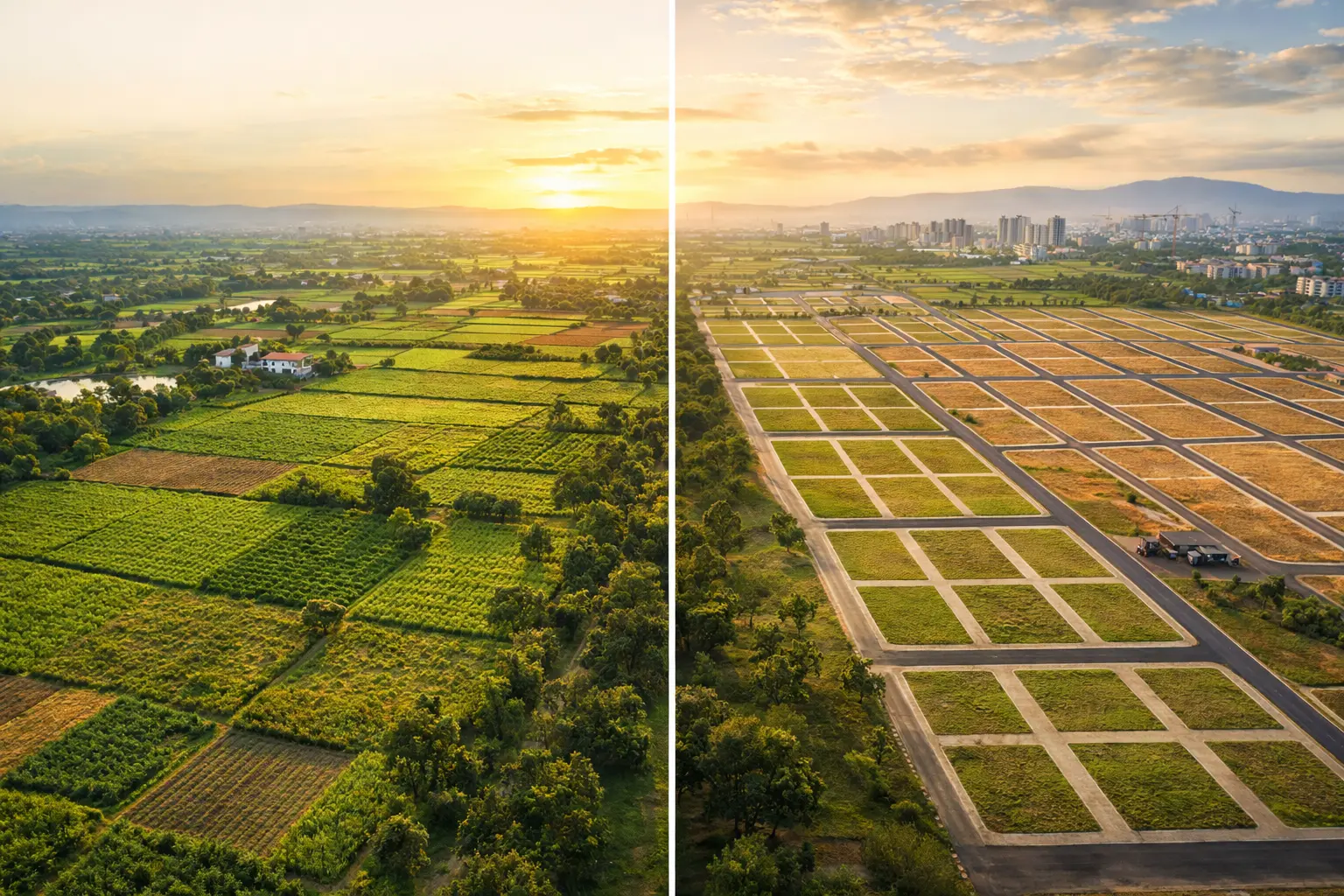
The Rise of Managed Farmland
Managed farmland is making agricultural investment more accessible by handling operations and maintenance.
This allows investors to benefit from farmland without direct involvement.
As this model grows, it is expected to play a key role in future land investments.
Agricultural Land vs Residential Plot: Key Questions Answered
1. Which is better: agricultural land or residential plot?
Agricultural land is better for long-term investment, while residential plots are suitable for faster returns and resale.
2. Is agricultural land a good investment in India?
Yes, agricultural land investment in India is considered strong due to limited supply and steady appreciation over time.
3. Do residential plots give better returns than farmland?
Residential plots can provide quicker returns, but farmland often delivers more stable long-term growth.
4. What are the risks of agricultural land investment?
The main risks include land verification, water availability, and location factors, which can be managed with proper due diligence.
5. Is residential plot investment safe?
Yes, residential plots are generally considered safe due to consistent demand and easier resale.
6. Which has better appreciation: land or plot?
Agricultural land typically offers steady appreciation, while plots grow faster in high-demand areas.
7. What is the future of land investment in India?
Both agricultural land and residential plots will grow, but farmland is gaining attention as a long-term asset.
Conclusion
Agricultural land vs residential plot is not about choosing one universally, but understanding how each fits your investment strategy.
Residential plots offer convenience and liquidity, while agricultural land provides long-term growth and stability.
The right choice depends on your goals, timeline, and investment approach.